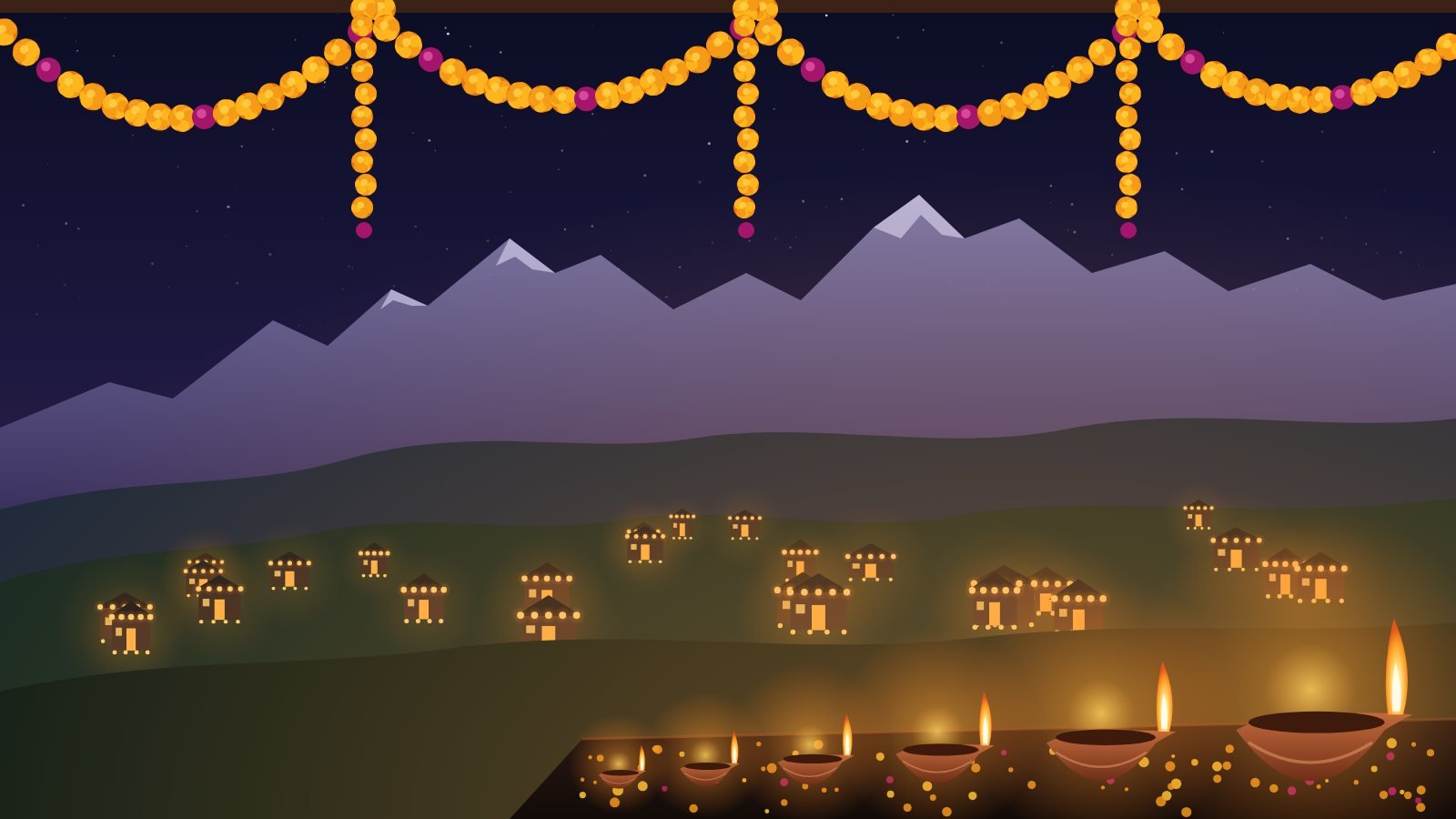
Tihar is often called Nepal's festival of lights, and on Laxmi Puja night every doorway, window and rooftop really does glow with oil lamps. But the lights are only the surface. Underneath, Tihar is a five-day festival about death, protection and gratitude, and about learning to see something sacred in every living being around us.
For us at Discover Parbat, Tihar in the hills of Parbat District is the most beautiful time of year to be in a Nepali village. This guide explains what each day of Tihar means spiritually, where the traditions come from, what the flowers and the seven-colour tika symbolise, and how to experience the festival respectfully if you are visiting Nepal, whether in Kathmandu or on a village trek like the Kokhe Danda Trek above Kushma.
The basicsWhat is Tihar?
Tihar (तिहार) is Nepal's second biggest festival after Dashain. It is celebrated over five days in the lunar month of Kartik, usually in late October or November, running from the thirteenth day of the waning moon to the second day of the waxing moon. The new-moon night in the middle is Laxmi Puja, the brightest night of the Nepali year.
The festival's traditional name is Yamapanchak (यमपञ्चक), "the five days of Yama". Yama, or Yamaraj, is the Hindu god of death and the judge of every soul's deeds. Naming the festival of lights after the god of death sounds strange at first, but it is the key to understanding Tihar. Each day honours a being connected to Yama, to protection or to life itself, and the festival ends with sisters praying for their brothers' long lives.
Tihar is celebrated by Hindus across Nepal and by Nepali-speaking communities in Darjeeling, Sikkim, Assam and the diaspora. The Newar community of the Kathmandu Valley celebrates the same days as Swanti, with its own rituals, including Mha Puja and the Nepal Sambat New Year.
Is Tihar the same as Diwali?
Tihar and Diwali share the same season, the same new-moon night of Laxmi Puja and the same theme of light over darkness. But Tihar has a character of its own. Nowhere else are crows, dogs, cows and oxen each given a day of worship. Bhai Tika, with its seven-colour tika and makhamali garlands, is far more central in Nepal than its Indian counterpart Bhai Dooj. And the Newar new year and self-worship of Mha Puja are uniquely Nepali. Nepalis often call the festival Deepawali too, but in everyday speech it is simply Tihar.
The storyYama and Yamuna: the legend at the heart of Tihar
The best-known story behind Yamapanchak is about Yama and his sister Yamuna, the goddess of the Yamuna river. Yamuna had long invited her brother to visit her, but the god of death was always too busy. When he finally came, during these five days of Kartik, she welcomed him with tika, garlands and a feast. Moved by her love, Yama declared that any brother who receives tika from his sister on this day would be protected from untimely death.
Nepali households tell a more homely version of the same idea. A sister was giving tika to her brother when Yama's messenger arrived to take his life. She begged him to wait until her ritual was finished: until the circle of oil she had poured around her brother dried, and the makhamali flowers in his garland wilted. The oil never dried and the makhamali never wilted, so the messenger had to leave without him. That is why sisters still draw a line of oil around their brothers and weave makhamali into their garlands on Bhai Tika.
Another tradition says Yama rests from his work for these five days and stays at his sister's home, which is why the period belongs to him. Whatever version your family tells, the meaning is the same: Tihar is a festival where love stands up to death. It does not pretend death is not there. It names it, honours it, and then fills the darkest night of the month with light.
CalendarTihar 2026 dates (2083 BS)
Tihar follows the lunar calendar, so the dates change every year. For 2026, the Nepal Panchanga Nirnayak Bikas Samiti (Nepal's calendar committee) has set the following schedule. This year the fourteenth lunar day falls during the daytime of Sunday 8 November and the new moon begins that evening, so Kukur Tihar and Laxmi Puja fall on the same day: dogs are honoured in the morning and Laxmi in the evening.
| Date (2026) | Nepali date | Observance |
|---|---|---|
| Fri 6 Nov | Kartik 20, 2083 | Dhanteras (Dhan Trayodashi) and Yama Deepdaan, lamps offered to Yama |
| Sat 7 Nov | Kartik 21 | Kaag Tihar, worship of crows |
| Sun 8 Nov | Kartik 22 | Kukur Tihar (morning), Narak Chaturdashi, and Laxmi Puja (evening) |
| Mon 9 Nov | Kartik 23 | Gai Puja, worship of the cow (some families honour the cow on Laxmi Puja morning or with Goru Puja, by family custom) |
| Tue 10 Nov | Kartik 24 | Govardhan Puja, Goru Puja, Mha Puja; Nepal Sambat 1147 begins |
| Wed 11 Nov | Kartik 25 | Bhai Tika (Yama Dwitiya, Kija Puja). Most auspicious time 11:07 AM |
Bhai Tika 2026: the committee has named 11:07 AM on Wednesday 11 November as the most auspicious time, with brothers sitting facing west and sisters facing east. Families still give tika throughout the day, so if you miss the exact moment, the blessing still counts.

Day by dayThe spiritual meaning of each day of Tihar
Day 1: Kaag Tihar, honouring the crow
Tihar begins on the rooftops. In the morning, families leave rice, grains, sweets and other food on a leaf plate or on the roof for crows. In Hindu belief the crow is Yama's messenger, a bird that carries news of sorrow and death. A crow cawing near the house was traditionally read as a sign that bad news was on its way.
Feeding the crow on Kaag Tihar is a way of asking the messenger to stay kind for the year ahead: to keep grief and loss away from the home. There is a gentler way to read it too. Crows are among the cleverest birds in the village, and they clean up what people throw away. Starting the festival by feeding them reminds us that even the birds we usually chase away are part of the web that keeps a village healthy.
Kaag Tihar usually comes the day after or alongside Dhanteras, when people buy new metal utensils, gold or silver for luck, and offer lamps to Yama in the evening (Yama Deepdaan).
Day 2: Kukur Tihar, honouring the dog
Kukur Tihar is the day the rest of the world remembers about Tihar, and for good reason. Every dog, whether a house pet, a farm dog or a street dog, is given a red tika on the forehead, a marigold garland around the neck and a special meal of meat, eggs, milk or sel roti.
The spiritual roots go back to Yama again. Two dogs, known in Nepali tradition as Shyam and Sabal, are said to guard the gate of Yama's kingdom. Honouring dogs on this day is believed to make them kind to the soul when its time comes, so the way to Yamalok stays open. Dogs are also associated with Bhairav, a fierce protective form of Shiva, and in the Mahabharata a dog stays loyally beside Yudhishthira all the way to the gates of heaven.
The everyday meaning is just as powerful. Dogs guard our homes, our fields and our livestock without asking for anything. Kukur Tihar is a day of thanks for loyalty and protection, and a yearly reminder to treat animals, especially the street dogs who live alongside us, with kindness. The same day is also Narak Chaturdashi, when people take a ritual bath in the hope of being freed from the fear of hell.
Day 3: Gai Tihar and Laxmi Puja, the cow and the goddess
In Hinduism the cow is a mother figure, giving milk, ghee and dung for fuel and for purifying floors, and she is the national animal of Nepal. On Gai Tihar, cows are bathed, given tika and garlands, and fed fresh grass and grain. The cow is seen as a form of Laxmi herself, the goddess of wealth and prosperity.
As darkness falls on the new-moon night of Kartik, the whole country prepares for Laxmi Puja. Houses are cleaned from top to bottom, floors are freshly plastered with red clay and cow dung in the villages, and a path of red footprints made with rice flour and red powder is drawn from the courtyard to the main door and on to the room where the goddess is worshipped. Oil lamps line the path so that Laxmi can find her way in. Rangoli patterns decorate doorways, and inside, families worship Laxmi with coins, jewellery, grain, fruit, sel roti and flowers. This night is also called Sukharatri, the night of happiness.
Some customs carry quiet lessons. Many households avoid giving away money or goods after the puja, so that prosperity does not leave the house, and in some families women tap a winnowing tray (nanglo) late at night, asking Alaxmi, the spirit of misfortune and disorder, to leave and Laxmi to stay.
Spiritually, Laxmi Puja is not simply a prayer for money. The goddess is invited into homes that are clean, bright and grateful. A tidy house, a lamp in every window and a family gathered together are themselves a kind of wealth. Many Nepalis also think of the lamps as an inner practice: lighting a small light against the darkest night of the month, and against the darkness inside ourselves.
Day 4: Govardhan Puja, Goru Tihar and Mha Puja
The fourth day carries several celebrations at once. Govardhan Puja remembers the story of young Krishna lifting Govardhan Hill on one finger to shelter the cowherds of Vrindavan from a week of storms sent by Indra, the king of the gods. Families shape a small hill of cow dung, decorate it with flowers and worship it. The lesson is humility: Krishna told the villagers to honour the hill, forests and cattle that actually fed them, rather than seeking favour from a proud god.
On Goru Tihar, oxen and bulls, the animals that plough the terraced fields of the hills, are given tika, garlands and good food after a year of hard work. For farming families in districts like Parbat this is a very real thank-you. Some communities also mark the day as Bali Puja, honouring the generous King Bali, and as Hali Tihar for ploughmen.
The same evening, the Newar community celebrates Mha Puja (म्ह पूजा), literally "worship of the self". Each family member sits before an elaborate mandala and the household worships their body and soul, praying for health and long life in the year ahead. It marks the first day of Nepal Sambat, Nepal's own lunar calendar, which begins the year 1147 on 10 November 2026. Of all the Tihar rituals, Mha Puja may be the most philosophical: the idea that the divine lives within each of us, and that our own body deserves care and respect.
Day 5: Bhai Tika, the love that protects life
The final day, Bhai Tika (भाइटीका), is the emotional heart of Tihar. Brothers travel home, sometimes across the world, to receive tika from their sisters. The sister walks around her brother, pours a line of oil in a ring around him, sprinkles water, places a long seven-colour tika (saptarangi tika) on his forehead and puts a garland of makhamali flowers around his neck. Many sisters also crack a walnut at the doorstep, a symbol of breaking any danger that might reach their brother.
Brothers then give tika to their sisters, the siblings exchange gifts and money, and the family shares a plate of sweets, dried fruit, nuts and sel roti called sagun. Cousins, relatives and close friends often take part too, so nobody without a brother or sister is left out.
Every part of the ritual echoes the Yama and Yamuna story: the oil ring is a boundary death cannot cross, the makhamali that never wilts is a wish for an unfading life, and the tika is a blessing placed where we feel thoughts arise. On the day named Yama Dwitiya, the festival of the god of death ends with sisters and brothers asking each other to live long.
SymbolsWhat the lamps, flowers and tika mean
Almost every object used during Tihar carries a meaning. Customs vary between families and communities, but these are the explanations you will hear most often in Nepali homes.

- Diyo (oil lamp): light over darkness, and a path lit for Laxmi on the new-moon night. Traditional clay lamps with mustard oil and cotton wicks are still lit in villages, alongside electric lights in the towns.
- Sayapatri (marigold): the name means "hundred petals". Bright orange and yellow marigold garlands are given to crows' offerings, dogs, cows, oxen and brothers, and hung over every door.
- Makhamali (globe amaranth): a small purple flower that stays fresh for weeks, so it stands for long life and an unbreakable bond between siblings.
- Saptarangi tika: a tall tika of seven colours given on Bhai Tika, often explained as a wish for a full, many-coloured life.
- Line of oil (tel ko dhara): a protective ring drawn around the brother, recalling the oil in the legend that never dried.
- Walnut (okhar): cracked at the doorstep by the sister to break obstacles and danger before they reach her brother.
- Laxmi's footprints: red footprints leading from the door to the shrine, inviting prosperity in and showing the goddess the way.
SongsDeusi and Bhailo: blessings sung door to door
On Laxmi Puja night and the nights that follow, groups of singers go from house to house playing the madal and singing Bhailo and Deusi. Traditionally Bhailo is sung by girls and women, mostly on Laxmi Puja night, and Deusi by boys and men, mostly on the night of Govardhan Puja. The household gives the singers money, sel roti, fruit and sweets, and in return the group blesses the home with prosperity and happiness for the year ahead.
The word Bhailo is linked to "bhalo", meaning wellbeing. The songs mention King Bali, with the singers announcing that they have not come on their own but were sent by King Bali. There are two main origin stories. One is the Puranic legend of the generous demon king Bali, whom Vishnu, as the dwarf Vamana, sent to the underworld but allowed to return to earth once a year. The other links the tradition to Baliraja, a medieval king of Jumla in western Nepal. Historians do not agree on which came first.
Whatever its origin, Deusi-Bhailo carries a beautiful idea: a blessing is something you give and receive. Today many groups play Deusi to raise funds for schools, clubs, temples or disaster relief, which keeps that spirit of sharing alive.
ReflectionThe deeper spiritual message of Tihar
When you look at the five days together, a pattern appears. The festival starts with the crow in the sky, moves to the dog at the doorway, then to the cow and the goddess inside the home, then to the hill, the ox and our own bodies, and finally to the people we love most. Each day draws the circle of reverence a little closer to the heart.

Several ideas run through all of it:
- Every being has a place in the sacred. Tihar is one of the few festivals anywhere that worships animals people often overlook: the noisy crow, the street dog, the working ox. It teaches gratitude to the whole web of life that supports a household.
- Death is faced, not hidden. By naming the festival after Yama and honouring his messengers and gatekeepers, Tihar accepts that life is fragile, and answers with care, love and light.
- Light begins at home. Laxmi is invited into homes that are clean and lit. The outer cleaning and lighting mirror an inner one: clearing out what is stale, and making room for good things.
- Respect starts with yourself. Mha Puja's self-worship reminds us that the body and mind we live in deserve care too.
- Family is a form of protection. Bhai Tika turns the love between siblings into a ritual promise to look after one another.
You do not need to be Hindu to feel the meaning of these days. Gratitude for animals, honesty about death, a clean and bright home and time with family are values almost anyone can recognise.
Local lifeTihar in Parbat's hill villages
In the cities, Tihar means strings of electric lights and busy markets. In the hill villages of Parbat District, west of Pokhara, it still feels much as it always has. Family members working in Kathmandu, Pokhara or abroad come home, and quiet villages suddenly fill with people. Houses are freshly plastered with red clay, marigolds and makhamali grown in courtyards are picked for garlands, and the smell of sel roti frying in big pans drifts between the houses.
After dark, the ridges come alive. Clay diyos line the edges of terraces and verandas, and groups of Deusi and Bhailo singers walk from house to house along the trails with torches, sometimes arriving long after midnight. Every house they visit gives them something, and every house gets a song and a blessing in return.

Homestay families along the Kokhe Danda Trek, in villages such as Haljure and Lespar, celebrate the festival at home like everyone else. If your trek falls during Tihar, you may see dogs wearing marigold garlands on the trail, lamps on the homestay veranda and Bhailo singers at the door. For many of our guests, being welcomed into a village household during the festival is a highlight of the trek. If you want to explore more of the district, our Parbat District travel guide covers Kushma, its bridges and the villages around it.
Visiting NepalTravelling and trekking during Tihar
Tihar falls in the middle of Nepal's autumn trekking season, when the skies are usually clear and the mountain views are at their best. It can be a wonderful time to visit, as long as you plan around the holiday.
Practical tips
- Book transport early. Buses and flights fill up before Laxmi Puja and again after Bhai Tika, as people travel home and back to work.
- Expect closures. Government offices, banks and many shops close on the main days, especially Laxmi Puja and Bhai Tika. Plan permits, cash and shopping beforehand.
- Plan around Bhai Tika. Guides, porters, drivers and homestay hosts want to be with their families on this day. A good trekking company will plan the itinerary with this in mind.
- Enjoy the lights in the evening. Laxmi Puja night is the best time to walk through a town or village. In Kathmandu, Patan and Bhaktapur the old squares glow with lamps.
Etiquette for visitors
- Do not step on the Laxmi footprints, rangoli or lamps on doorsteps, and take off your shoes before entering a room where puja is taking place.
- Ask before photographing a family puja or a Bhai Tika ceremony. Most people are happy to say yes, but it is their family moment.
- If a Deusi or Bhailo group sings for you, it is polite to give a small amount of money or some food.
- If you are offered tika or sagun, accept it with your right hand or both hands. It is a blessing, not just a decoration.
- Be gentle with the garlanded dogs, and do not feed them anything harmful such as chocolate.
Want to see a village Tihar for yourself?
Our village treks from Pokhara stay in family homestays where the festival is still celebrated the traditional way. See the day-by-day itineraries and prices on our trek pages.
Kokhe Danda Trek → Panchase Trek → Khopra Ridge Trek →FAQFrequently asked questions about Tihar
What is the spiritual significance of Tihar?
Tihar, also called Yamapanchak, is a five-day festival dedicated to Yama, the god of death, and his sister Yamuna. Spiritually it is about facing death with love: each day honours a being connected to protection or life, from crows and dogs to cows, oxen, the self and finally siblings, and the darkest new-moon night of Kartik is filled with lamps for Goddess Laxmi.
Why is Tihar called Yamapanchak?
Yamapanchak means the five days of Yama. According to legend, Yama, the god of death, visited or rested at the home of his sister Yamuna during these days, and she honoured him with tika and garlands. Pleased, he blessed brothers who receive tika from their sisters with protection from untimely death.
When is Tihar in 2026?
Tihar 2026 runs from Saturday 7 November (Kaag Tihar) to Wednesday 11 November (Bhai Tika). Kukur Tihar and Laxmi Puja both fall on Sunday 8 November, Gai Puja on Monday 9 November, and Govardhan Puja, Goru Puja and Mha Puja on Tuesday 10 November, when Nepal Sambat 1147 begins. Dhanteras is on Friday 6 November.
What is the auspicious time for Bhai Tika in 2026?
The Nepal Panchanga Nirnayak Bikas Samiti set 11:07 AM on Wednesday 11 November 2026 (Kartik 25, 2083) as the most auspicious time for Bhai Tika, with brothers facing west and sisters facing east. Families still give tika throughout the day.
Why do Nepalis worship dogs during Tihar?
In Hindu belief, two dogs named Shyam and Sabal guard the gate of Yama's kingdom, and dogs are linked to Bhairav. Honouring dogs on Kukur Tihar is believed to make them kind to the soul after death. It is also a day of thanks for the loyalty and protection dogs give, including street dogs.
What is the difference between Tihar and Diwali?
Both share the new-moon night of Laxmi Puja and the theme of light over darkness. Tihar is distinctly Nepali in honouring crows, dogs, cows and oxen on separate days, in the central role of Bhai Tika with its seven-colour tika and makhamali garlands, and in the Newar celebration of Mha Puja and the Nepal Sambat New Year.
What is Mha Puja?
Mha Puja means worship of the self in Nepal Bhasa. On the fourth day of Tihar, Newar families sit before mandalas and worship their own body and soul, praying for health and long life. It marks the start of the Nepal Sambat New Year, which in 2026 begins year 1147 on 10 November.
What do makhamali flowers and the seven-colour tika mean?
Makhamali (globe amaranth) stays fresh for weeks, so sisters use it in garlands as a wish for their brother's long life. The saptarangi, or seven-colour, tika given on Bhai Tika is a blessing for a full and colourful life.
Can tourists take part in Tihar?
Yes. Visitors are usually welcome to watch the lamps on Laxmi Puja night, listen to Deusi and Bhailo singers and, if invited, receive tika. Ask before photographing family rituals, do not step on rangoli or Laxmi footprints, and give a small gift to Deusi or Bhailo groups who sing for you.
Is Tihar a good time to trek in Nepal?
Tihar falls in the autumn trekking season, when skies are usually clear. Book transport early because buses and flights fill up before Laxmi Puja and after Bhai Tika, expect offices and banks to close on the main days, and remember that guides and homestay hosts will want to be with family on Bhai Tika.
SourcesReferences
- Nepal News. Kukur Tihar and Laxmi Puja being celebrated together today, 8 November 2026. english.nepalnews.com
- OnlineKhabar English. Auspicious time for Bhai Tika this year is 11:07 am, November 2026. english.onlinekhabar.com
- Collegenp. Tihar 2083 schedule announced by the Nepal Panchang Nirnayak Bikas Samiti. collegenp.com
- The Rising Nepal. Cultural events to greet Nepal Sambat 1147, 3 November 2026. risingnepaldaily.com
- myRepublica. Yama Panchak defined. myrepublica.nagariknetwork.com
- OnlineKhabar (Nepali). Kukur Tihar and the gatekeeper dogs Shyam and Sabal, Rastriya Samachar Samiti. onlinekhabar.com
- OnlineKhabar English. Deusi-Bhailo history in Nepal. english.onlinekhabar.com
- Ekantipur. Deusi-Bhailo: musicians sent by King Bali, 2025. ekantipur.com
- Asia News Network / The Kathmandu Post. Farmers in Nepalese village pluck makhamali flowers as Tihar nears, 2024. asianews.network