
What is Vijaya Dashami?
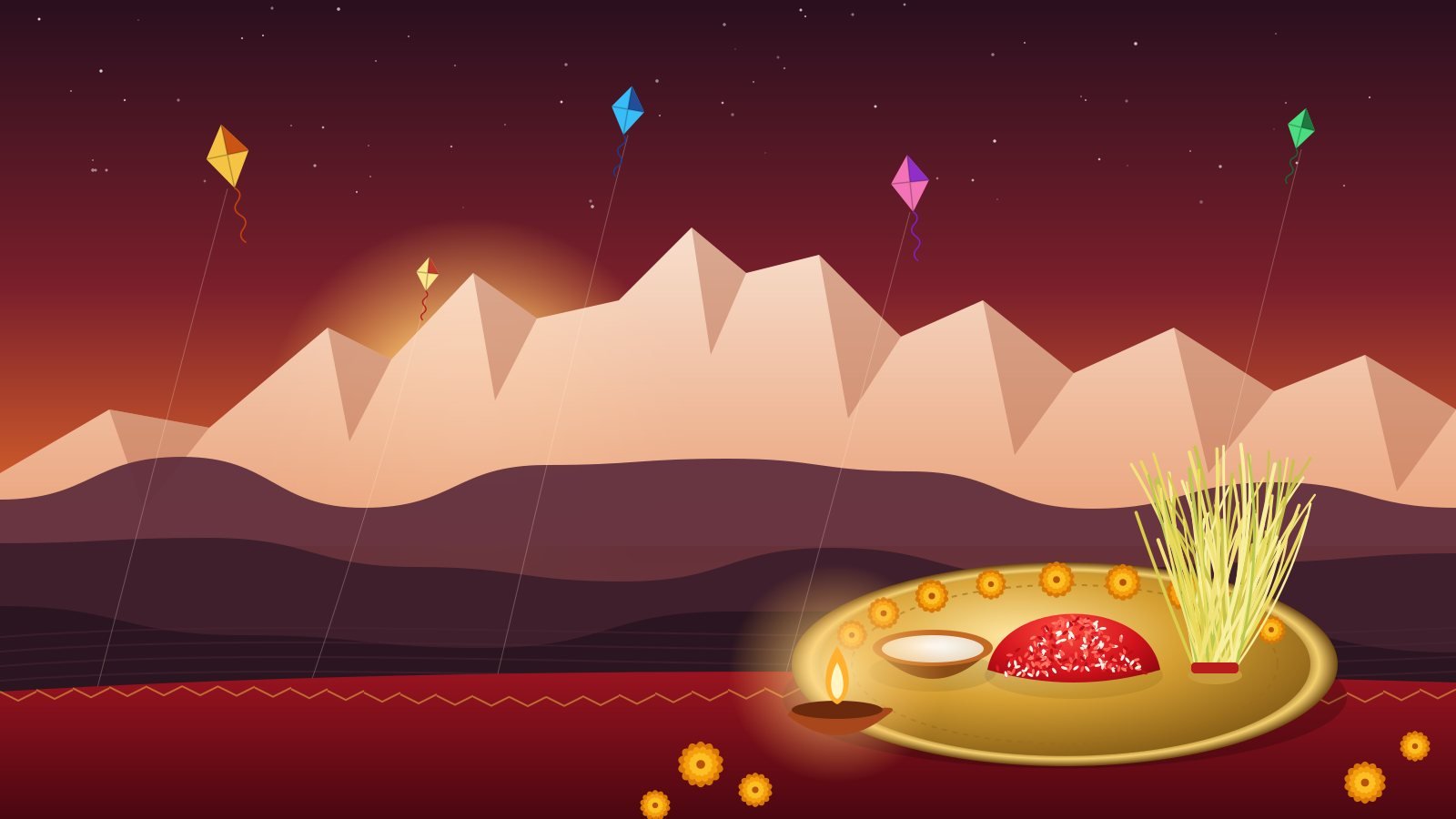
If you are in Nepal in October and see people walking the streets with a bright red mark on their forehead and a tuft of yellow-green grass tucked behind one ear, you have arrived on Vijaya Dashami.
The name says it all. Vijaya means victory, and Dashami means the tenth day of the lunar fortnight. Vijaya Dashami is the "victorious tenth", the high point of Dashain, Nepal's longest and most important festival. Across the Hindu world the same day is known as Dussehra or Dasara, and in Bengal it closes Durga Puja.
At its heart, the day celebrates one simple idea that every culture understands: good triumphs over evil. Two great stories carry that idea. In one, the goddess Durga destroys the buffalo demon Mahishasura. In the other, from the epic Ramayana, Prince Rama defeats the ten-headed demon king Ravana. In Nepal, the goddess is at the centre of the celebration; in much of India, Rama is. Both stories end on this tenth day.
The first storyThe goddess who did what the gods could not
Durga and Mahishasura
Long ago, a demon named Mahishasura, who could take the form of a mighty buffalo, performed years of fierce devotion. Pleased, the creator god Brahma granted him a boon. Mahishasura asked for near-immortality: no man and no god would be able to kill him.
Drunk on this power, he stormed the heavens, drove out the gods and claimed their thrones. One by one, the gods went into battle against him, and one by one they failed. His boon protected him from every one of them.
In desperation, the gods gathered together. Their anger and their combined divine energy blazed out as a single dazzling light, and from that light a goddess took shape: Durga, "the invincible one". Mahishasura had asked for protection from men and gods. He had never imagined being challenged by a woman.
Each god gave her a weapon. Shiva gave his trident, Vishnu his discus, Indra his thunderbolt, and the mountains of the Himalaya gave her a lion to ride. With ten arms and every weapon of heaven, she rode out to meet the demon army.
The battle raged for nine days and nine nights. Durga fought Mahishasura's generals and his shape-shifting tricks; as she struck, he changed from buffalo to lion to elephant and back. Out of her own fury emerged fierce forms such as Kali, who defeated the demon Raktabija, whose every drop of spilled blood would otherwise have spawned a new demon. On the tenth day, as Mahishasura emerged from his buffalo form, Durga pinned him beneath her foot and struck him down with her trident.
Order returned to the universe. That tenth day of victory became Vijaya Dashami.
The gods could not win alone. Only their combined power, taking a feminine form, could defeat the evil that threatened everyone.
This is why Dashain is, above all, a celebration of Shakti, the divine feminine energy that Hindus see as the active, creative power behind the universe. The nine nights before Vijaya Dashami, known as Navaratri, honour nine forms of the goddess, the Navadurga, from the gentle mountain-born Shailaputri to the fierce, dark Kalaratri. Temples to Durga, Kali and Bhagwati are busy from dawn throughout the festival.
The second storyRama, Ravana and the rescue of Sita
The Ramayana's final battle
Rama, prince of Ayodhya and an incarnation of the god Vishnu, was sent into fourteen years of forest exile with his wife Sita and his loyal brother Lakshmana. In the forest, Ravana, the brilliant but arrogant ten-headed king of Lanka, tricked the brothers away from their hut and carried Sita off to his island kingdom.
Rama searched for her with the help of Hanuman, the devoted monkey god, and an army of monkeys and bears. They built a bridge of floating stones across the sea to Lanka and laid siege to Ravana's golden city.
In many tellings, before the final battle Rama prayed to the goddess Durga for strength, worshipping her through the nights before the fight. Blessed by her, he faced Ravana, a fearsome opponent whose heads grew back each time they were cut off. Finally, Rama loosed a divine arrow into Ravana's heart. The demon king fell, and Sita was free.
That victory is remembered on the same tenth day. Twenty days later, Rama's homecoming to Ayodhya is celebrated as Diwali, which in Nepal falls during the festival of Tihar.
Ravana is not a cartoon villain. In the epic he is learned, a great devotee of Shiva, a skilled musician and a capable ruler. His downfall comes from pride, desire and refusing to let go of what was never his. That is part of the story's power: even great gifts are destroyed by unchecked ego.
Same day, different emphasis
| Where | Main story | What you might see |
|---|---|---|
| Nepal (Dashain) | Durga's victory over Mahishasura | Elders giving tika and jamara, family gatherings, goddess temples, kites and swings |
| North India (Dussehra) | Rama's victory over Ravana | Ramlila plays, giant effigies of Ravana burned at dusk |
| Bengal (Durga Puja) | Durga's victory and her return home | Elaborate goddess idols immersed in rivers on Dashami |
Beyond the legendsThe spiritual meaning of Vijaya Dashami
For many Nepalis, Dashain is first a family reunion and a holiday. But underneath the feasting, the festival carries ideas that are surprisingly universal, whatever your own beliefs.
The real battle is inside
Hindu teachers often read these stories as maps of the inner life. Mahishasura, the buffalo, stands for inertia, brute instinct and ignorance. Ravana's ten heads are sometimes interpreted as ten negative tendencies that every person carries, and which have to be overcome one by one:
Seen this way, Vijaya Dashami is not only about a victory that happened long ago. It is an invitation to win your own small victories: over anger, over arrogance, over the habits that hold you back.
Nine nights of preparation
The nine nights of Navaratri are often understood as an inner journey. Devotees fast, pray and reflect, moving from the fierce forms of the goddess, which destroy what is harmful, to the gentler forms that bring prosperity and wisdom. Only after that preparation does the tenth day, the day of victory, arrive.
Strength that protects
Durga is both fierce and motherly. She is called Ma, mother, by devotees, and she fights not for conquest but to protect. Her story honours feminine power as the force that restores balance when everything else has failed. It is a striking image to see a whole country celebrate.
Blessing and renewal
On Vijaya Dashami, elders bless the young, and the young bow to the old. Old quarrels are traditionally set aside, and relatives who have not spoken all year come to the same courtyard for tika. It is a festival of continuity, of one generation passing its good wishes to the next.
A mix of rice, yogurt and red vermilion pressed on the forehead. Red is the colour of Shakti and of good fortune; the tika carries the goddess's blessing.
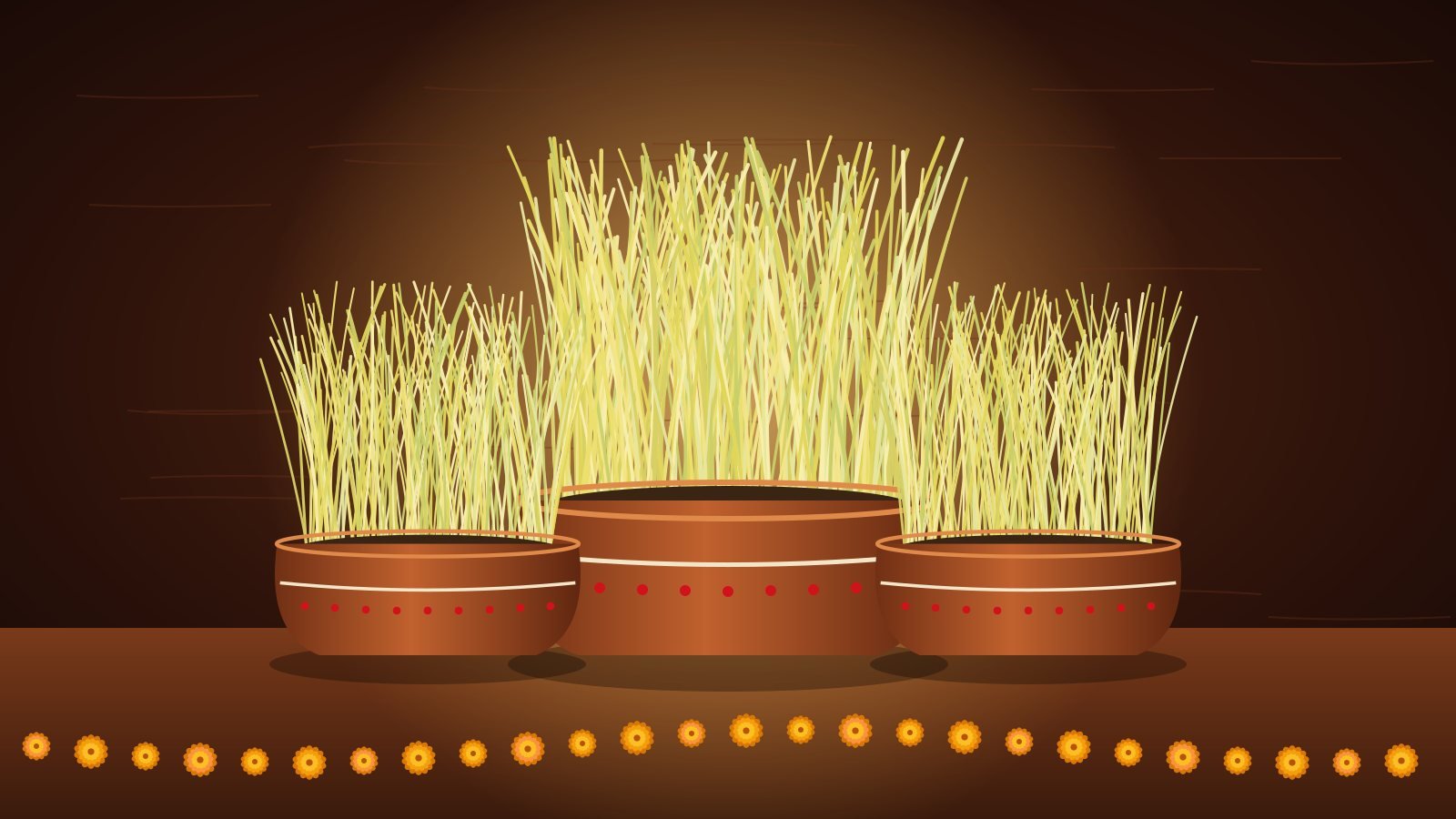
Barley sown on the first day and grown in a dark prayer room for nine days. The pale yellow-green shoots symbolise growth, fertility and a good harvest.
As they place the tika, elders recite blessings for long life, health, learning and success in the year ahead.
A small gift of money given with the tika, often crisp new notes, especially loved by children.
In NepalHow Dashain builds to Vijaya Dashami
Dashain stretches over fifteen days, from the new moon to the full moon, but a handful of days carry the main rituals. Here is how it unfolded in 2026:
- GhatasthapanaA sacred clay vessel (kalash) is set up in the family prayer room, and barley seeds are sown in sand and soil to grow the jamara.
- Fulpati"Sacred flowers and leaves" are carried in procession, historically from the old royal town of Gorkha to Kathmandu's Hanuman Dhoka palace, and brought into homes.
- Maha AshtamiThe fiercest forms of the goddess are worshipped. Temples are crowded, and many families make offerings for a family feast.
- Maha NavamiVehicles, tools and machines are blessed so they serve their owners safely through the year, from taxis and buses to farm tools and laptops.
- Vijaya DashamiThe goddess is ritually bid farewell, and families gather at the home of their most senior members to receive tika and jamara in order of age.
- Visiting and Kojagrat PurnimaFamilies keep travelling to receive tika from relatives further afield, until the full moon night of Kojagrat Purnima, when Lakshmi, goddess of wealth, is worshipped.
What a Vijaya Dashami morning looks like
Each year an astrological committee announces the most auspicious moment to receive tika; in 2026 it was 10:26 in the morning. Families dress in their best clothes, many in new outfits bought for the festival. The eldest member of the household sits facing east, and the younger relatives line up, usually facing west, to bow and receive the tika, the jamara behind the ear and a blessing. Then the household moves on to visit grandparents, uncles and aunts, sometimes collecting so much tika that foreheads are thick with red rice by evening.
Food is central: goat curry, beaten rice, pickles, sweets and plenty of tea. Animal offerings remain part of the festival in many homes and temples, though some families and temples now offer pumpkins, coconuts or fruit instead.
Kites, swings and card games
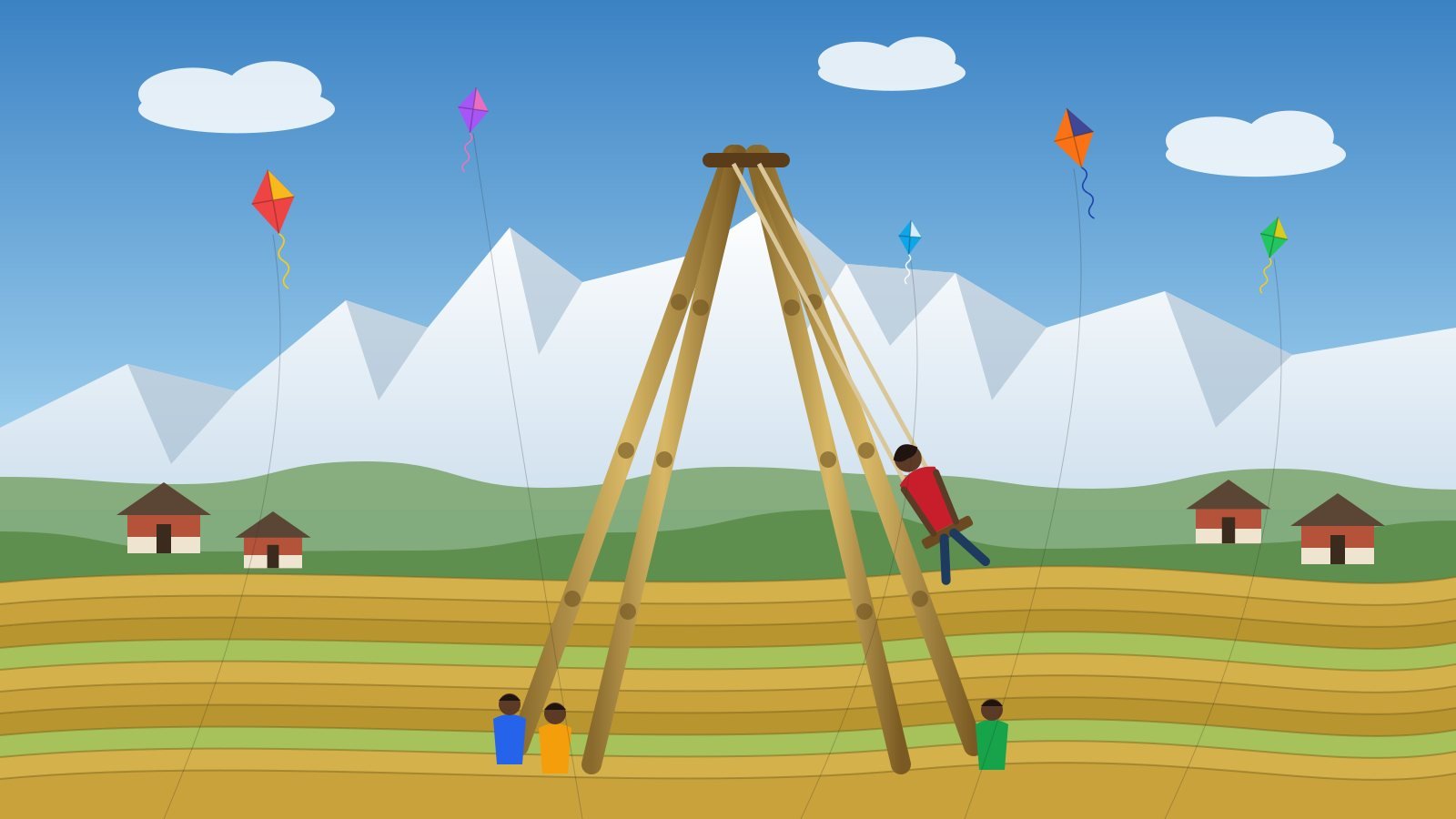
Dashain falls when the monsoon has cleared and the autumn sky turns blue, so children and adults fill it with kites, competing to cut each other's strings. In villages, huge bamboo swings called ping are built from bamboo poles and rope, and everyone, from toddlers to grandparents, takes a turn. Evenings are for family card games and long conversations.
Dashain in Nepal's hill villages
In cities, Dashain is when Kathmandu empties out, as millions travel back to their home villages. In the hills, including villages across Parbat, the festival feels at its fullest: houses freshly plastered with red clay, families reunited after months apart, swings in every settlement and terraced fields turning golden for the rice harvest. Nepal's many communities mark it in their own ways. For Newars, the season is known as Mohani, and some families give white tika rather than red.
For visitorsExperiencing Vijaya Dashami as a traveller
Being in Nepal for Dashain is a privilege. Nepalis are proud of the festival and famously generous with guests, and many travellers find themselves invited in for tika, tea or a meal. A few pointers help you join in gracefully.
If you are invited to receive tika
- Accept warmly. It is a genuine gesture of welcome, not a performance for tourists.
- Let the elder lead. Sit or kneel in front of them, bow your head slightly, and let them place the tika and jamara.
- Receive any prasad (blessed food) or fruit with your right hand, or with both hands.
- Thank them and offer festival greetings. Touching an elder's feet is a family custom, so you don't need to, but a respectful namaste is always right.
- Ask before photographing people during worship or tika, particularly elders.
- If you prefer not to eat meat, simply say so politely. Vegetarian guests are completely normal in Nepal.
Practical tips for travelling during Dashain
Many shops, offices and some restaurants close for several days, especially around Vijaya Dashami. Buses and domestic flights are packed in the days before, as people travel home, and again afterwards as they return, so book well ahead and expect higher demand. On the other hand, the weather is usually superb and trekking trails are in their prime.
Tip: Trekking during Dashain is wonderful, but some teahouses are run by families who may be away celebrating. A local guide or operator will know which lodges are open and can often arrange for you to share part of the festival with a host family.
The best way to understand Vijaya Dashami is to see it from inside a family home rather than from the street. On our Multiple Viewpoints Trek, the route finishes through the villages of Parbat with a family homestay in Lespar, and we can build a custom trek around the festival dates so you can share Dashain or Tihar with a Nepali family.
Frequently asked questions
What does Vijaya Dashami mean?
Vijaya means victory and Dashami means the tenth day of the lunar fortnight. It is the "victorious tenth", the climax of the 15-day Dashain festival in Nepal, celebrating the triumph of good over evil.
Is Vijaya Dashami the same as Dussehra?
It falls on the same day and shares the same roots. In much of India, Dussehra focuses on Rama's victory over Ravana, often with effigies of Ravana burned at night. In Nepal, Dashain centres on the goddess Durga's victory over the buffalo demon Mahishasura, and on elders giving tika and blessings to the family.
When is Vijaya Dashami in 2026?
Vijaya Dashami fell on Wednesday, 21 October 2026. Dashain began with Ghatasthapana on 11 October, and families continue giving tika until Kojagrat Purnima, the full moon a few days later.
Can foreigners receive Dashain tika?
Yes. If a Nepali family invites you to receive tika, it is a warm gesture of welcome. Bow your head slightly, receive the tika and jamara from the elder, accept their blessing and any prasad offered, and thank them. A simple "Dashain ko shubhakamana" (Happy Dashain) is always appreciated.
Is Dashain a good time to visit Nepal?
Yes, it coincides with clear post-monsoon trekking weather. Expect some shops and offices to close, buses and flights to be busy as people travel home, and a festive, hospitable mood, especially in villages.